

Collection
Sit Down Quiet
A haunting legacy of oppression and resilience
For many Aboriginal people of the Gascoyne, Carnarvon was not a place of freedom but a place of control.
From the late nineteenth century, Aboriginal people were subject to government laws that regulated where they could live, work and travel. Police, magistrates and station owners enforced these laws, and many Aboriginal people were arrested, imprisoned or returned to stations against their will.
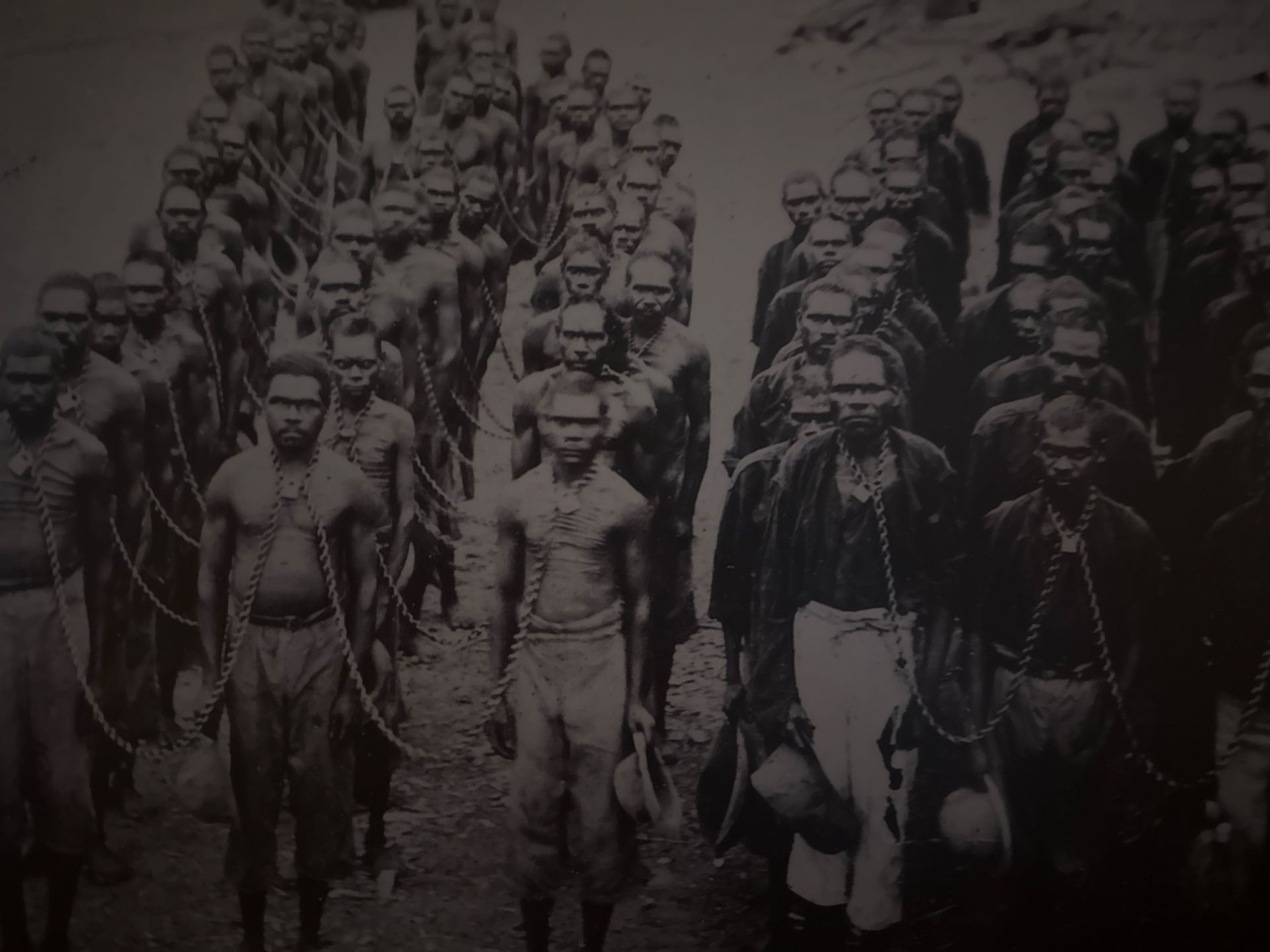
Some were brought to Carnarvon in neck chains. Others were sentenced to imprisonment on Rottnest Island, separated from their families and Country, with many never returning home.
Aboriginal prisoners also provided labour that helped build Carnarvon, including roads, the jetty and the tramway.
The photographs in this display bear witness to a difficult chapter in the history of the Gascoyne and remind us of the strength and resilience of those who endured it.
“When I was a young girl I went with some of the old people down to the camps where they did their singing and dancing… A policeman came along with Yamatji people in chains. It was a really sad sight. All our old people had to sit down quiet and not make any noise. The old people then made up a new song called ‘Poor fella, my people’. When they sang the song, I started to cry. Sometimes, even now, I sing this song to myself and it always makes me cry.”
Lilly Milly, Yamatji, 1992
The Permit System
From the 1880s until the mid-twentieth century, many Aboriginal people working on pastoral stations lived under a government permit system.
Station owners were issued permits to employ Aboriginal workers and were responsible for providing rations and basic medical care. Aboriginal people could not freely leave the station without permission. Those who did could be pursued by police, returned to the station or imprisoned.
In 1882, the colonial government established a police station, courthouse and jail in Carnarvon under Resident Magistrate Charles Foss. These institutions became central to enforcing government control over Aboriginal people throughout the Gascoyne.
Hundreds of Aboriginal men and women were imprisoned under these laws. Some were convicted of offences such as stock theft or violence, while others were prosecuted for actions directly related to restrictions on their freedom of movement and employment.
Neck chains continued to be used on Aboriginal prisoners in Western Australia until 1946.
Men in Neck Chains, Carnarvon Jetty, c.1907
Groups of Aboriginal men were chained together and marched from inland stations to Carnarvon for imprisonment. Historical records show that neck chains were also used when transporting Aboriginal witnesses and patients to hospital.
Photograph courtesy of the Kerry Stokes Collection.
MAKE IT YOUR OWN