

Collection
First Mission
Missions, Training and the Removal of Children
During the late nineteenth and early twentieth centuries, government authorities, churches and pastoralists introduced policies that sought to control many aspects of Aboriginal people’s lives. Missions, station training homes and government institutions were established with the stated aim of educating and “civilising” Aboriginal children, but they also separated many children from their families, languages and cultural traditions.
These stories reflect the experiences of Aboriginal people in the Gascoyne during this period and the resilience of families who maintained their connections to Country and culture despite these policies.
The First Mission
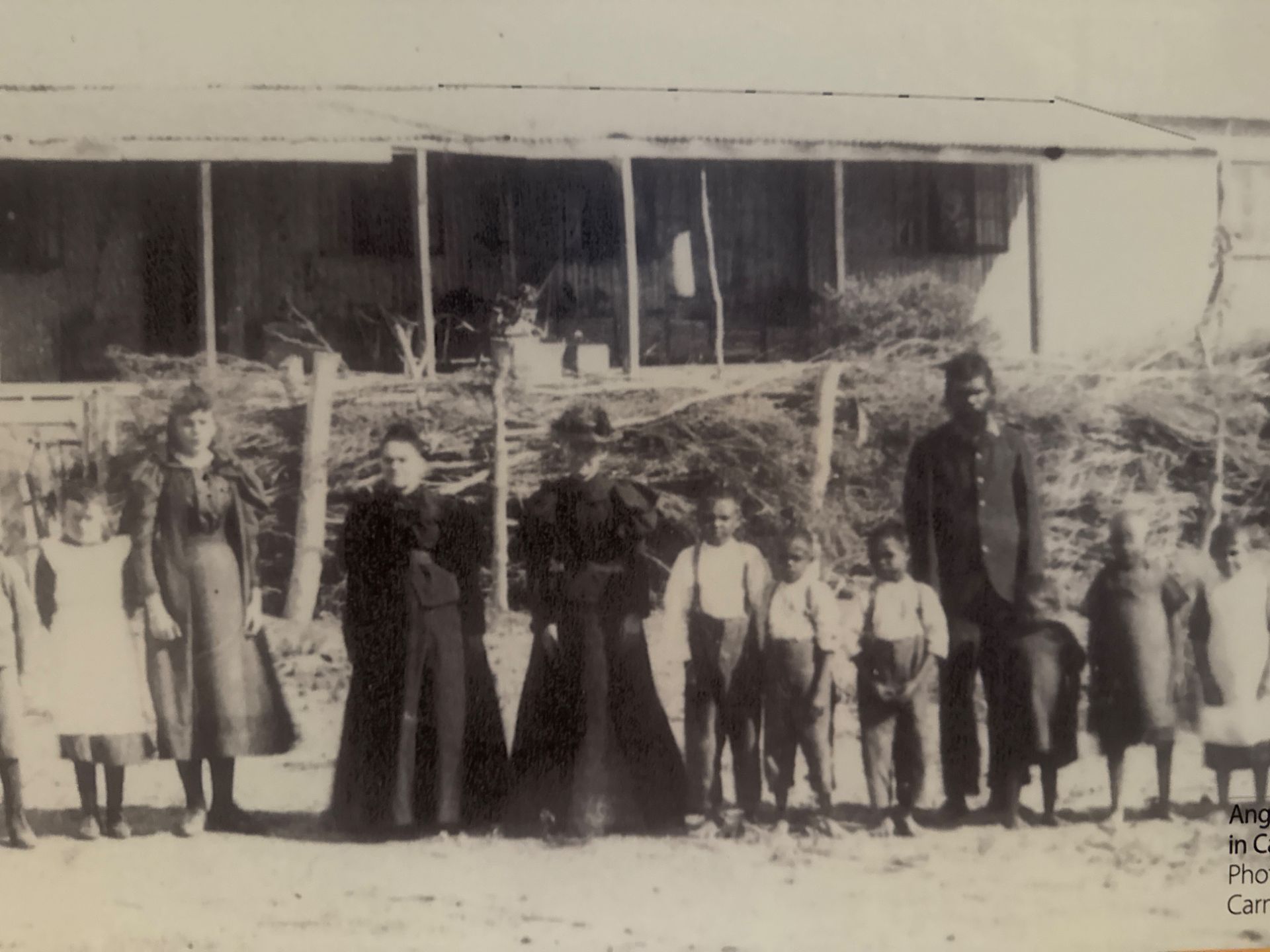
In 1886, Reverend John Gribble established the first mission for Aboriginal people near Carnarvon, on the northern side of the Gascoyne River. Known as Galilee Baba, the mission operated for less than a year.
Gribble became outspoken about the treatment of Aboriginal people on pastoral stations, accusing some settlers of exploitation, violence and cruelty. His criticism created significant controversy within the colony.
In his 1886 book Dark Deeds in a Sunny Land, Gribble wrote:
“Even in Australia, under its sunny skies, deeds—the most dark and horrible in their nature—have been committed and are still being practised.”
The book attracted attention in Britain, prompting the British Government to seek an explanation from the Western Australian colonial administration and bringing international attention to conditions experienced by Aboriginal people in the region.
Remembering the Mission School
“This may be the Anglican school for Aboriginal children in Carnarvon opened by Gribble in the 1880s. My grandfather, Old George Cooyou, told us he attended school there as a little boy, but when the school closed no Aboriginal children had the chance to go to school again for many years.”
— Gwen Peck, 2011
Minilya Station
“To Make Good Servants”
When Donald and Charlotte McLeod took over Minilya Station in 1898, they established a privately operated training home for Aboriginal children.
Their stated aim was to “civilise and Christianise” Aboriginal children and prepare them for domestic service and station labour. Between 1898 and 1905, twenty-three children were trained at Minilya. Girls were commonly sent to work as domestic servants in Carnarvon households, while boys were trained for station work.
Today, these practices are recognised as part of broader colonial policies that sought to control Aboriginal lives, limit cultural identity and provide a workforce for the pastoral industry.
A Williambury Story
Tommy Ah Hong
Tommy Ah Hong was the son of a Chinese station worker and an Aboriginal woman living at Williambury Station.
Unlike many non-Aboriginal fathers of the time, Tommy’s father acknowledged his son and wrote to Henry Prinsep, Chief Protector of Aborigines, asking where Tommy could receive an education. He also contributed financially to his schooling.
In 1904 Tommy was sent to Ellensbrook, near Margaret River, a small institution established for children described at the time as “half-caste”—a historical term that is no longer used and is included here only because it reflects the language of official records.
After two years, Tommy returned to Williambury to live with his father, his Aboriginal family and community, and worked as a cart boy. Little is known about his later life, and the identity of his Aboriginal mother has not been recorded in surviving historical documents.
MAKE IT YOUR OWN