

Collection
Tools of Life, Culture and Country
Cultural artifacts reflecting Indigenous heritage and survival
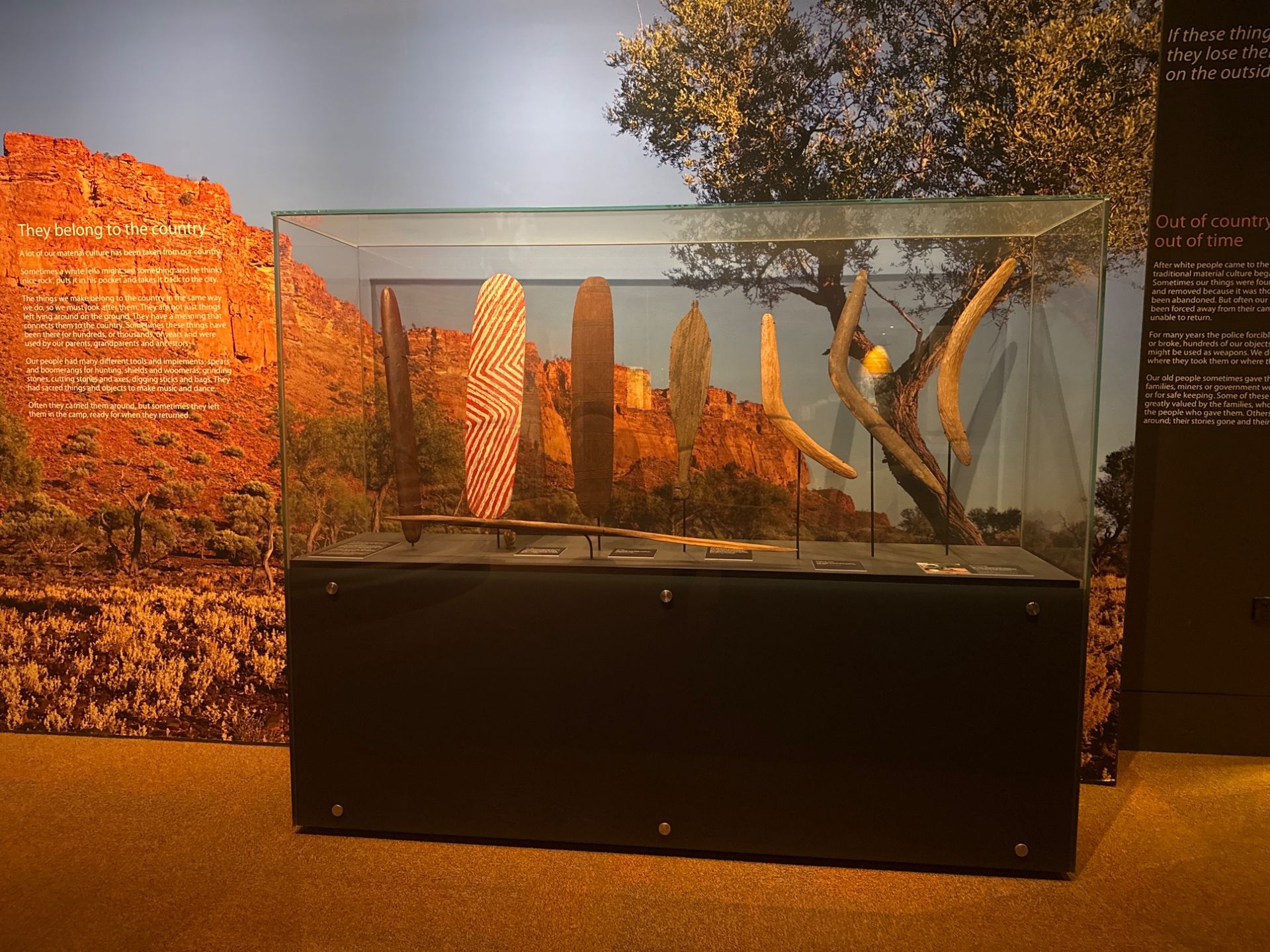
For thousands of years, Aboriginal people of the Gascoyne crafted tools from the natural resources of Country. Every object had a purpose, whether for hunting, gathering food, making fire, ceremony or protection. Many also carry stories that connect people, places and the Dreaming, preserving cultural knowledge across generations.
The objects in this showcase reflect the skill, ingenuity and enduring traditions of the Yinggarda, Thadgari, Bayungu and neighbouring peoples. Together, they tell stories of survival, identity and the deep relationship between people and Country.
Wana (Digging Stick)
The wana is one of the most important traditional tools used by Aboriginal women. Strong and heavy, it was used to dig for edible roots and tubers, uncover small burrowing animals, break bark and branches, and hunt animals such as wallabies. It could also serve as a defensive weapon when needed.
This wana was likely made and carried by Thadgari people from the Williambury Station area. In 2009 it was returned to Gwoonwardu Mia, where it continues to share its story with visitors.
The wana is also connected to an important Dreaming story. It tells of a heavily pregnant woman pursued by the devil Ngudjidi, who sought to harm her. When her escape was blocked by the Gooch Ranges, she struck the rock face with her wana, splitting the range apart to create Mundili Gap, allowing her to escape. The story explains the formation of this significant landscape feature and reflects the enduring connection between cultural knowledge and Country.
Shields (Jiwara or Bugali)
Shields provided protection in combat while also expressing regional identity through their distinctive carved grooves and painted designs.
One shield displayed here was made by Chubby Jones, a Yinggarda man, at Cane River in 1973. Its red and white ochre markings and carved grooves are characteristic of shields from the Gascoyne region. It was presented to Gavin Mason as a gift.
The second shield is believed to have been made many years earlier in Yinggarda or Thadgari Country, representing the long tradition of shield making practised across the region.
Both shields were donated by Gavin Mason.
Spear Thrower (Mambarra / Mirru)
The spear thrower is an ingenious hunting tool that increases both the distance and force with which a spear can be thrown.
This example is believed to have been made many years ago in Yinggarda or Thadgari Country, near Williambury Station. Its leaf-shaped form is typical of spear throwers from the Gascoyne.
Originally, a wooden peg at the base held the spear in place. The peg was secured using heated spinifex resin, a remarkable natural adhesive that hardens like stone when cooled.
In the Bayungu language this tool is known as Mambarra, while in Thalanyji it is called Mirru.
Donated by Peter Tomlinson.
Digging Stick
Digging sticks were everyday tools used to uncover edible roots, tubers and small burrowing animals hidden beneath the ground. They were an essential part of daily life, enabling families to gather food sustainably while drawing on detailed knowledge of seasonal plants and animal habitats.
Donated by Gavin Mason.
Boomerangs
Boomerangs made in the Gascoyne were practical hunting tools rather than returning boomerangs. Different sizes and shapes were crafted for different purposes, reflecting the knowledge and skill of their makers.
The three boomerangs displayed here were all made in the Gascoyne and demonstrate the diversity of traditional hunting implements used throughout the region.
Also displayed is a photograph of Bob Williams shaping a boomerang in 1974, capturing the continuation of this important cultural practice.
Boomerangs donated by Peter Tomlinson and Gavin Mason. Photograph courtesy of Dennis Gray, 1974.
MAKE IT YOUR OWN